


AUTHOR


You've probably seen people talking in your feeds.
LinkedIn reach is down. Organic is dead. AI has flooded every feed with content that sounds the same.
A lot of SDRs have taken that as a sign to give up on posting altogether and just double down on cold outreach.
Here's the problem with that.
If you're showing up in someone's inbox with no profile, no content, and nothing to back up your pitch, you're starting from zero every single time.
No trust, no context, no reason for them to take you seriously.
The SDRs who are actually winning right now are pairing outbound with content.
Not to go viral.
Not to rack up impressions.
To make every cold email and every DM land a little warmer than it would have otherwise.
This is the exact playbook we use at Tangerine Drift to help sales teams do that.
Five steps, built around the tools and content types we've seen work consistently with clients.
Before we get into the system, it's worth understanding what posting actually does for a sales rep.
Because it's not about vanity metrics.
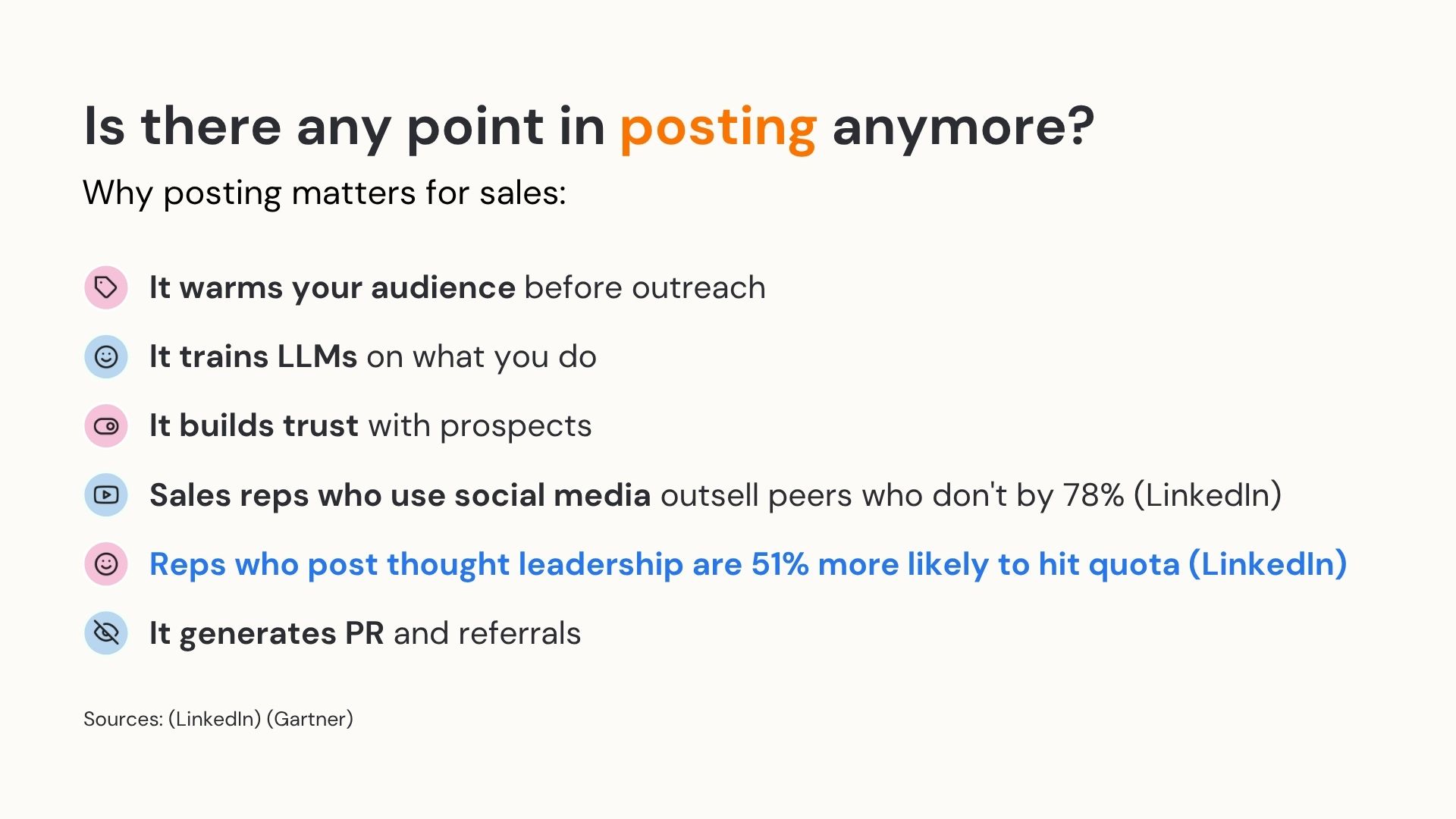
According to LinkedIn's own data, SDRs who use social media have outsold their peers by around 78%.
Reps who post thought leadership content are 58% more likely to hit quota.
That's not a coincidence.
Here's what content is doing behind the scenes, even when your follower count is small.
If a prospect has seen your posts a few times before your cold email lands, you're no longer a stranger.
They've got context on what you do and how you think.
That changes the conversation before it even starts.
When someone gets a message from you and checks your LinkedIn, what do they find?
A blank page with a job title and a profile photo?
Or a feed that shows you actually know your stuff?
Content is doing the selling while you sleep.
This one's underrated.
If people are engaging with your content and mentioning your brand in comments and posts, AI has a reference point for who you are and what problem you solve.
That matters more and more as buyers start their research in ChatGPT or Perplexity instead of Google.
At Tangerine Drift, a few posts have led to podcast invites, blog collaboration requests, and warm inbound leads.
None of that happens if you're not showing up consistently somewhere.
The point is: you don't need a huge following to get a return.
You need a system that connects content to outbound activity.
A lot of SDRs open a blank LinkedIn post and start typing.
That's the wrong starting point.
Before you write anything, you need to know who you're writing for and where they're already spending time online.
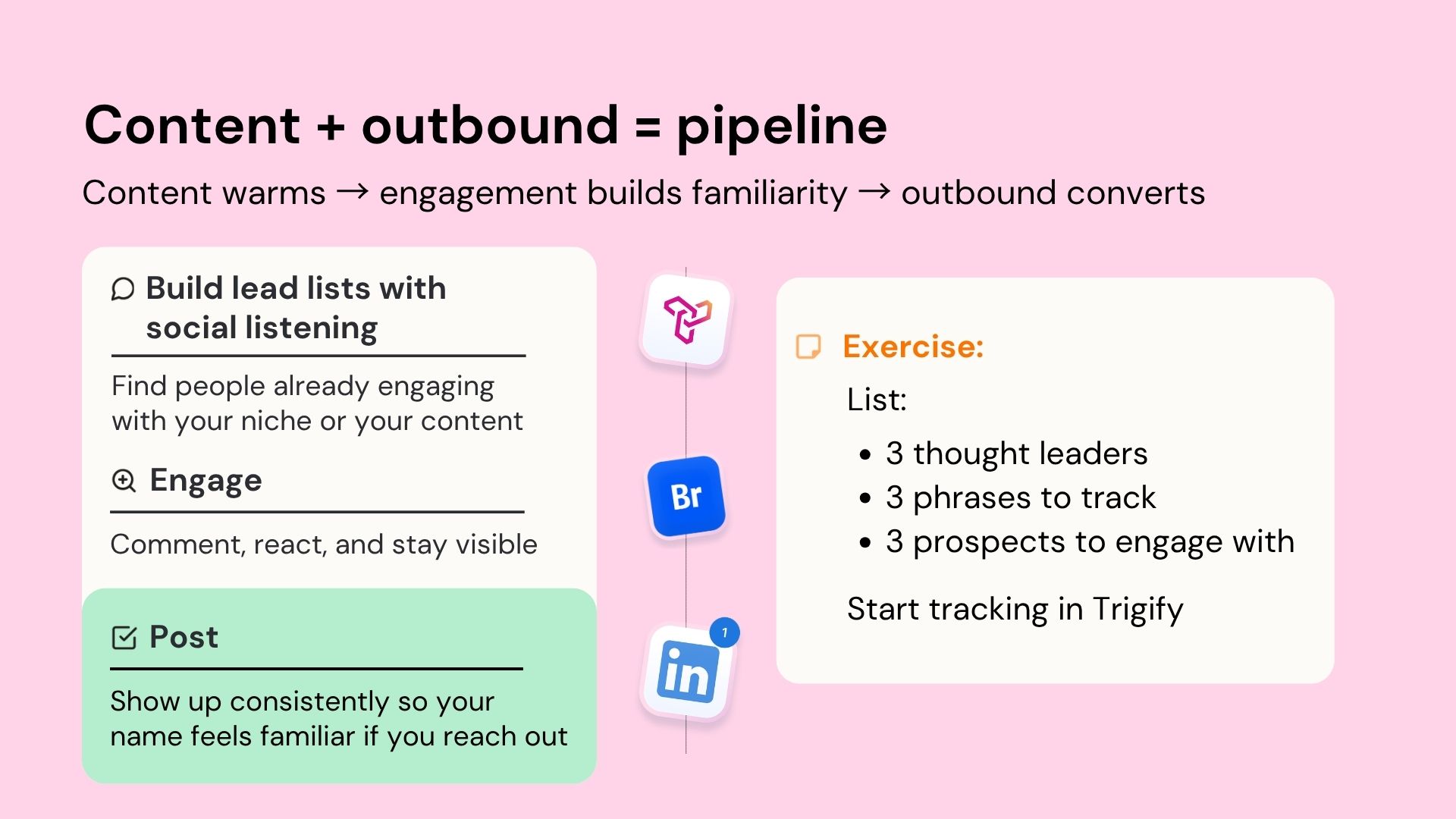
The fastest way to do that is social listening.
We use a tool called Trigify for this.
It builds a live feed of posts from people who are talking about your niche.
You set it up by tracking keywords, phrases, and thought leaders in your space.
Trigify then shows you all the posts related to those topics, across the people you're watching.
The real magic is what you do next.
Instead of just looking at the posts, you look at who's engaging with them.
The people liking and commenting on posts about your topic are already interested in it.
They're not cold.
They're telling you exactly what they care about, publicly, in real time.
Pull those people into your pipeline.
Connect with them. Start engaging with their content.
You're building a warm list of future prospects before you've sent a single outreach message.
As a starting point:
That's your Trigify setup in a nutshell.
The reason so much sales enablement content fails to land is that it's written for a vague, imaginary person.
Too broad. Too generic. Too safe.
The content that gets SDRs results is written for one person with one specific problem.
To do that well, you need to actually know your buyer.
Here's the research process we use at the studio when we're creating content marketing for sales teams in a new industry.
What does your ICP's world currently look like?
What trends are shaping their role right now?
Stats give you credibility and they give you conversation starters.
You don't need to post there.
But TikTok's search engine is genuinely brilliant for finding out what's catching attention in a niche.
You can see which content is performing, what questions people are asking, and what's resonating with a particular persona.
Use it as a research tool.
Search for your ICP's job title or their main pain points and read what they're actually asking peers.
Reddit is where people drop the professional filter and talk honestly about what's hard. That's gold for content ideas.
Tools like Answer the Public will show you what people are asking AI and Google around your topic.
Those questions are your content brief.
From all of that, map out four things:
That last one matters more than people give it credit for.
There's a difference between a platform your ICP is present on and a platform they're engaged on.
Scrolling past posts is not the same as commenting, sharing, and starting conversations.
You want the latter.
Where your ICP is consuming and interacting with content should directly influence where you post.
More on that in a minute.
The deeper you go on this research, the sharper your content gets.
You stop writing for a vague "HR Leader" and start writing for the CPO who's employee engagement is tanking and is being pressured by their CEO.
That specificity is what makes content feel like it was written for someone, not at them.
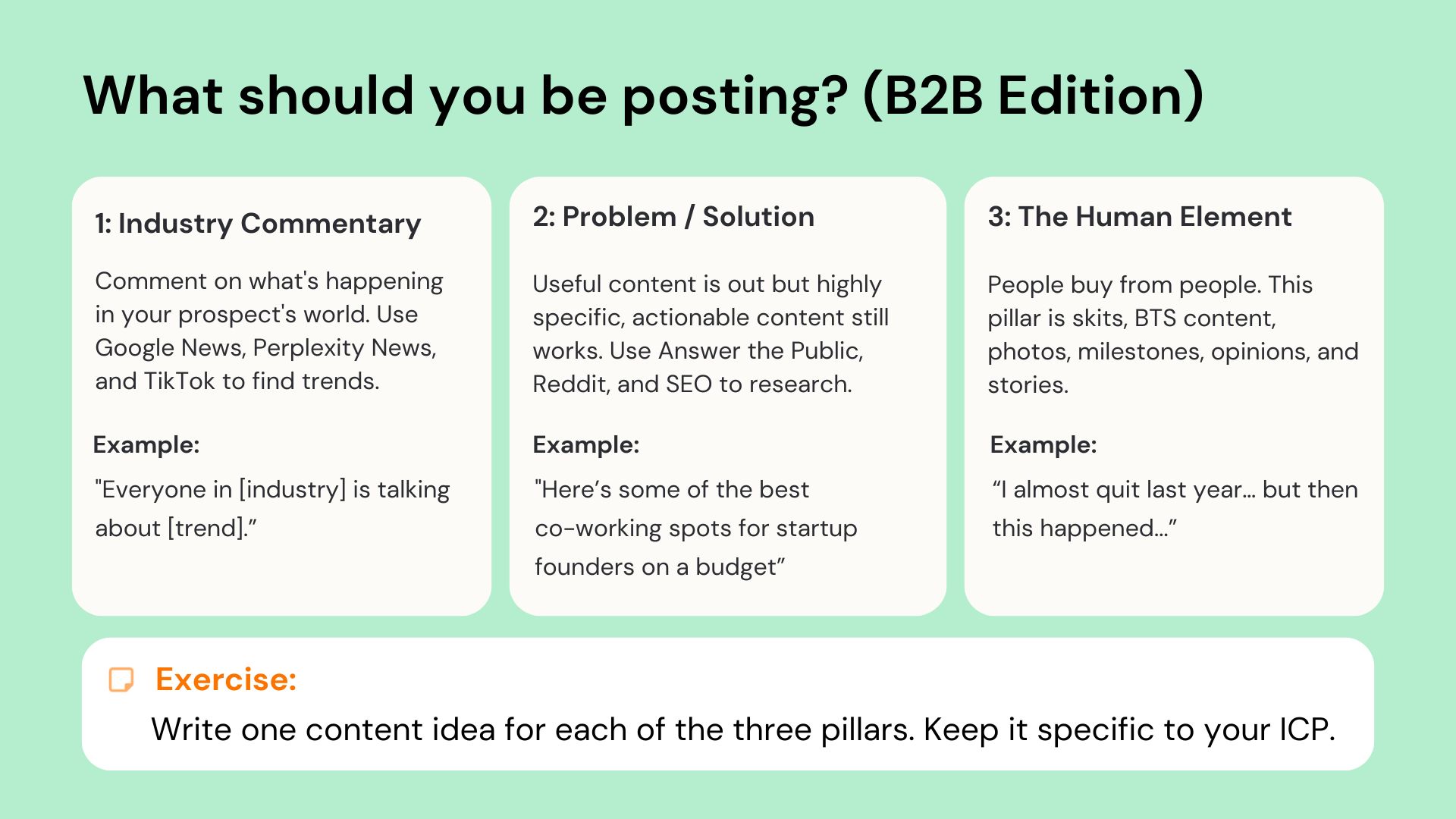
We've produced over 500 posts at the studio. These are the three pillars we come back to again and again because they perform consistently across industries.
Take something happening in your ICP's world right now and react to it.
A trend, a shift, a stat, a debate that's playing out in their industry.
Give your take. Ask a question. Invite a response.
This works because it signals that you're paying attention.
You're plugged into what's going on in their world, not just pushing your product.
It builds the kind of credibility that makes a cold message feel a lot less cold.
Generic tips are dead.
Buyers can ask ChatGPT for tips.
What they can't get from AI is your specific workflow, your team's exact process, the thing you tried that actually worked.
So instead of posting
"five tips to improve your outreach,"
post the actual sequence you tested, what changed when you changed it, and what result it drove.
Show the framework. Make it so specific and so actionable that someone could copy it tomorrow.
That's the difference between useful content and actionable content.
Useful gets scrolled past. Actionable gets saved and shared.
Thanks to AI, people are more hungry for real human content than they've been in years.
Personal storytelling, milestones, behind-the-scenes posts, honest reflections on what's working and what's not.
This content builds trust faster than anything else because it lets people see who you actually are.
Buyers aren't just buying your product.
They're buying you.
Especially in B2B, where relationships matter.
One post idea for each pillar, written for your ICP, is a solid starting point.
Pick the one that feels most natural and start there.
Here's where a lot of SDRs go wrong.
They default to LinkedIn because it feels obvious for B2B.
And LinkedIn is a great platform for building relationships and warming pipeline.
But it's not built for organic reach.
Its algorithm prioritises networking over distribution.
If growing your audience is part of the goal, there are better places to do it.
Reddit is one of them.
We ran a community-led campaign for a client called Virtuall, focused on Reddit and Discord.
In one month, those posts drove 384,000 views, 3,500 upvotes, and a 1,400% increase in web traffic, bringing over 5,000 new visitors to their site.
You can read the full story in the Virtuall case study.
What makes Reddit powerful for sales is that the conversations are honest.
People are more direct there.
You can get real feedback on your product, real questions from potential buyers, and real engagement from people who are genuinely interested in your topic.
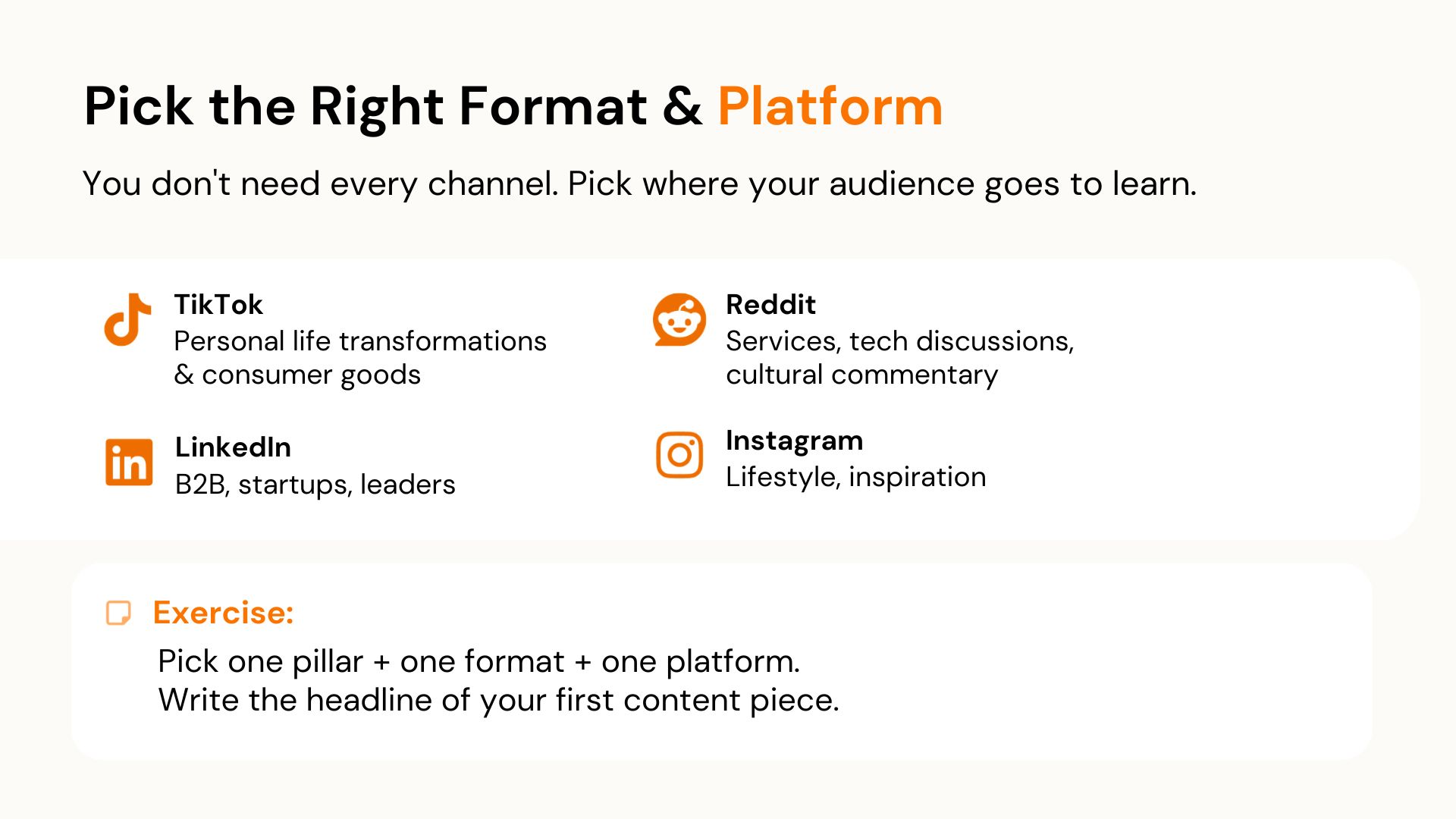
Instagram and TikTok work well for certain B2B audiences too, especially if your ICP skews younger or is more active on those platforms outside of work hours.
Threads is quietly becoming a strong platform for selling, particularly for founders and consultants who want a lower-friction way to build in public.
The question to ask is:
where is your ICP actually engaged?
Not just present. Engaged.
Where are they commenting, sharing, responding?
That's where you post.
Pick one platform.
Pick one format.
Write a headline for your first piece of content.
That's all you need to get started.
Content without outbound is slow.
Outbound without content is cold.
The combination is what fills pipeline.
Here's how to connect the two.
Once you've built a list of prospects through social listening, you need a way to stay on top of what they're posting so you can engage consistently.
Two tools that make this easier:
Breakcold is a social selling CRM that builds a LinkedIn feed from your pipeline.
You can see your prospects' recent posts, leave comments, track who you've engaged with, and spot when a lead is warm enough to reach out to.
It takes the guesswork out of "have I been showing up for this person?"
MyFeedIn is another tool worth adding to your stack for monitoring and feed curation, keeping you plugged into what your pipeline is actually saying without having to manually scroll LinkedIn for hours.
The workflow looks like this.
That outreach message lands completely differently from a cold one.
They know who you are.
They've seen what you do.
You're not starting from zero.
The close is where you qualify them. Can you actually help?
Is there a fit?
That conversation is easier to have with someone who's already warmed up to you.
And because you've been engaging with their content and tracking their activity, you've got real context to personalise your message around.
You're not guessing at their pain points.
You've watched them talk about them.
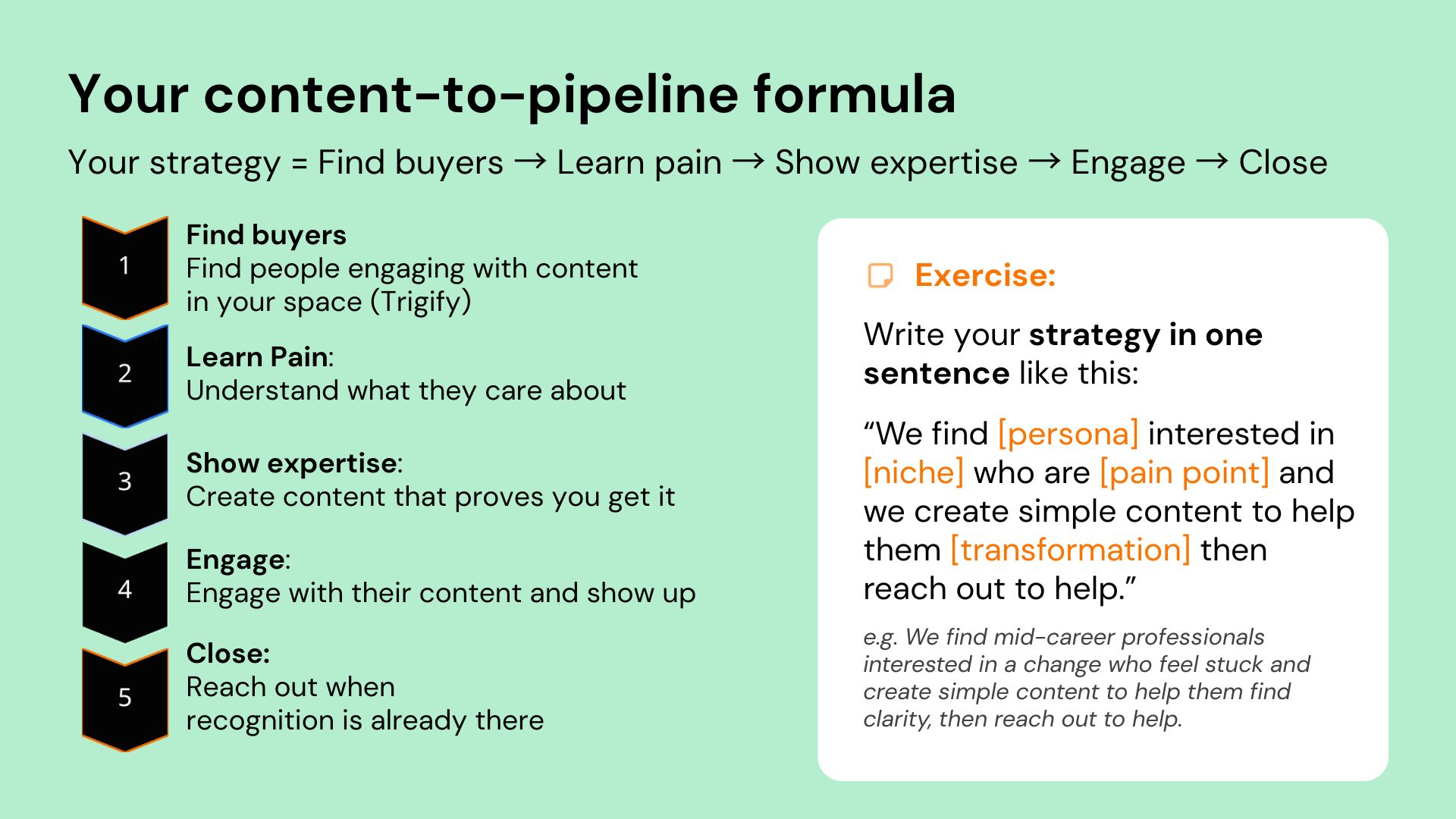
Before you do anything else, write this down.
We find [persona] interested in [topic] who are experiencing [pain point], and we create simple content to help them [transformation], then reach out to help.
For example:
We find sales leaders interested in social selling who are struggling to get reps to post consistently, and we create simple content to help them build a system their team will actually use, then reach out to help.
(Oops literally what this post is about)
That sentence does two things.
It clarifies your strategy for yourself.
And it becomes a prompt you can feed into any AI tool when you're planning content,
Because it defines exactly who you're talking to and what you're trying to do for them.
Everything in this playbook flows from that sentence.
If you've read this and you know your team should be doing this
But you're not sure you have the time or the internal resource to make it happen consistently,
That's exactly the problem we solve.
At Tangerine Drift, we run a 14-day sprint for sales teams that takes you from strategy to live content in two weeks.
We learn your product, your reps' voices, and your GTM.
Then we build the content, the visuals, and the system so your team can show up on socials without it eating their selling time.
Most teams spend 30 minutes a week reviewing and posting. We handle everything else.
Start your 14-day sprint here or find out more about how it works.


.png)
